
Online Trust Statistics (2026): Consumer Trust, Online Reputation, and What Drives Buying Decisions
When consumers buy from or hire businesses they don’t know, the decision requires trust. Before the money moves, someone opens Google, reads a few reviews, glances at a website, and either continues or backs out. It happens millions of times a day.
To understand what actually drives those decisions, we surveyed 1,146 US adults about how they decide which businesses to trust online. We asked how often they’ve walked away from a business for lack of information, how often they’ve worried a business wasn’t legitimate, what they do to check a business out before spending money, which trust signals earn their business the most, whose word they weigh more heavily, and whether reputation matters more when the stakes are high.
The findings can be summarized in three main points: 1) Buyers cross-reference before they trust, 2) They weigh outside sources over inside sources by a wide margin, 2) They walk away when they can’t find enough to be confident.
👉 Get the full 2026 Online Trust Report
Key Online Trust Statistics
- 87.7% of Americans have decided not to hire or buy from a business because they couldn’t find enough information about it online. 73.4% have done it more than once.
- 55.6% say positive online reviews are the most significant way a business can earn their trust. 20.8% said the business being featured in the news or industry media was the biggest trust factor.
- 94.2% of Americans trust what other people and outside sources say about a business more than what the business says about itself. Only 4.5% weigh the business’s own words more.
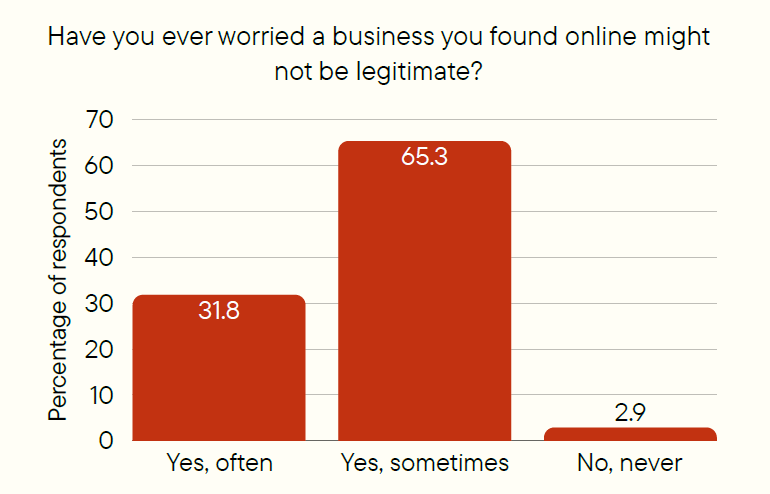
- 97.1% have worried that a business they found online might not be legitimate, and 31.8% experience this often.
- 68.0% of buyers check a business’s website before spending money, but only 13.0% say the website is the biggest factor in earning their trust.
- Gen Z is significantly more likely than older generations to be skeptical of a business’s legitimacy. 44.4% of Gen Z said they worry often, compared with about 27% of Gen X and Boomers.
- Adults 55 and older are 4.6x more likely than adults under 35 to say showing up in an AI assistant’s answer is the best way to earn their trust (10.5% vs. 2.3%).
- 81.7% of Americans say a business’s reputation and online presence matter more when the purchase is expensive or important. 46.9% say it matters much more.
How Often Buyers Walk Away From Businesses They Can’t Vet
We asked respondents whether they’d ever decided not to hire or buy from a business because they couldn’t find enough information about it online. Nearly everyone has.
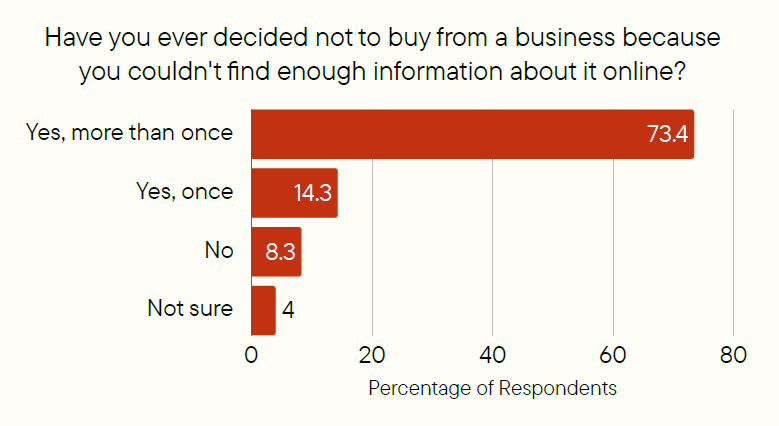
87.7% of Americans have walked away at least once, and 73.4% have done it more than once. Only 8.3% say they’ve never done it.
The rate varies slightly across demographics. Millennials come in highest at 89.9% and Boomers lowest at 81.7%. Women (88.6%) and men (86.6%) sit within a point of each other.
Where the number moves significantly is based on online shopping frequency. 90.7% of those who shop online at least weekly have walked away, compared with 82.2% of monthly-or-less shoppers. More experienced online buyers walk away from unverifiable businesses more often, which makes sense since they shop more often.
🎯 Why It Matters
Every walk-away is a lost sale. The businesses closing sales aren’t just the ones with the best offer. They’re the ones a nervous buyer can verify quickly.
How Consumers Vet Businesses Online
Before spending money with a business they don’t already know, most people run more than one check.
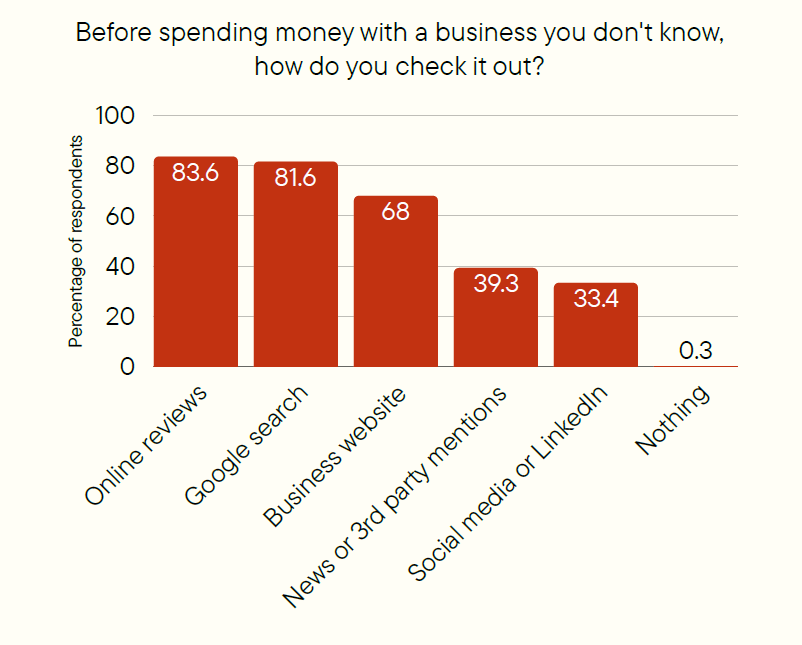
Reviews and Google searches lead. Two-thirds of buyers pull up the business’s website. About four in ten look for third-party mentions such as news coverage. A third check social media or LinkedIn.
The average respondent uses 3.06 verification methods, and 69.3% use three or more. Only 13.0% rely on a single method or nothing at all. The remaining 87% cross-reference before they buy.
45.3% of respondents skip both news mentions and social media. For nearly half of consumers, whatever surfaces in Google is the entire picture. Any business relying on a single strong channel is invisible to a meaningful share of its own buyers.
What Earns Consumer Trust
We asked respondents which of five signals would earn their trust in a business the most. They could select only one answer, so it measures the single strongest lever rather than the full weight of every signal.
| Top trust signal | Percentage of respondents |
|---|---|
| Positive online reviews | 55.6% |
| Being featured or written about in the news or industry media | 20.8% |
| Professional website | 13.0% |
| Strong social media presence | 6.0% |
| Showing up when you ask an AI assistant like ChatGPT | 4.6% |
Positive reviews win easily, which isn’t surprising. The more revealing finding is where the other signals fall. Media coverage was the second most popular answer, nearly 8 percentage points ahead of the business’s website, and outpaces social media presence by more than 3x. It’s the second-strongest trust signal in the study, and the one that is often the most challenging for businesses to improve.
Grouped together, third-party signals dominate. 76.4% of respondents chose either reviews or press coverage as their top trust builder. Only 19.0% chose a channel the business controls directly.
The next question points in the same direction. 94.2% of Americans said they trust what other people and outside sources say about a business more than what the business says about itself. Only 4.5% weigh the business’s own word more heavily. That’s a 21-to-1 ratio in favor of outside sources.
The two biggest trust builders (reviews and press coverage) are the two a business can’t fully control. What earns trust in 2026 is what a buyer finds when they go looking outside the business’s own website. A business investing only in the channels it owns is missing the signals its buyers weight most heavily.
A Professional Website Is Expected
68.0% of buyers check a business’s website before spending money, but only 13.0% say the website is what earns their trust the most. Buyers expect businesses to have professional websites, but that’s really just a baseline expectation.
Among the 779 respondents who check a business’s website, 85% named something else as the biggest trust builder. The site works as a hygiene factor. Not having one costs the sale. Having a great one doesn’t win it on its own.
The pattern is sharpest among older buyers. Only 3.6% of adults 65 and older said the website was their top trust signal, roughly a third of the rate in every group under 55.
Pouring the entire visibility budget into a website redesign while doing nothing to build third-party credibility. In this dataset, no owned channel beats reviews or press coverage as a trust builder. A great website matters, but only after the reviews, search results, and third-party mentions have already convinced a buyer to click through.
Nearly Every American Has Wondered If a Business Was Real
Concern about whether a business is legitimate is close to universal. 97.1% of Americans have worried about it at some point, and 31.8% worry about it often. Only 2.9% said the thought has never crossed their mind.
The concern drives behavior. Among respondents who worry about legitimacy often, 93.1% have walked away from a business at least once, 74.7% run three or more verification checks, and 48.1% look for news mentions when vetting a business.
Gen Z leads on this measure. 44.4% of Gen Z said they worry often, compared with 30.7% of Millennials, 26.7% of Gen X, and 27.0% of Boomers.
📈 Trend Watch
The volume of unfamiliar online businesses has grown faster than the tools to check them out. In an environment where AI-generated storefronts and fake review farms both exist, buyers reach for third-party validation as a shortcut. The businesses that show up in reviews and press coverage benefit from that instinct. The ones that don’t get lumped in with the fakes.
Press Coverage Is the Second Most Trusted Signal
20.8% of Americans named being featured in the news or industry media as the biggest trust builder. That places press coverage second only to reviews and ahead of every channel a business controls.
The heaviest verifiers weigh press coverage the most. Buyers who already look for news mentions when vetting a business are 1.8x more likely than others to name media coverage as their top trust signal (28.4% vs. 15.8%).
The audience for press coverage also skews older, which matters for anyone selling to established buyers. 33.7% of adults 65 and older named press coverage as their top trust builder, roughly twice the rate among 25- to 34-year-olds.
💡Pro Tip
Press coverage compounds. One mention won’t shift a buyer’s opinion, but a steady presence in outlets a buyer respects builds a footprint they can find when they go looking. The businesses that show up in more than one place get short-listed.
How Generations Vet Businesses Differently
Age is where the study produces its sharpest differences. Gen Z is the most suspicious and the most thorough. Boomers put the most weight on established third-party sources.
Among Gen Z respondents, 44.4% worry often about legitimacy, 21.3% use all five verification methods, 46.9% look for news mentions when vetting a business, and the average number of methods used is 3.24. Every one of those figures is the highest of any generation. Boomers sit at the other end, with 27.0% worrying often, 7.8% using all five methods, and an average of 2.84 methods per buyer.
Where the two groups converge is on the fundamental posture. Every generation weighs outside sources over inside ones. They just get there different ways. Gen Z runs a heavier verification stack and worries more about being deceived. Boomers lean on the press and, unexpectedly, on AI.
AI Visibility as an Emerging Trust Signal
AI visibility placed last of the five trust signals overall. 4.6% of Americans named it as the biggest trust builder in the study, or 53 respondents total.
The interesting finding is who those respondents are. Adults 55 and older picked AI visibility at 10.5%. Adults under 35 picked it at 2.3%. That’s a 4.6x difference in the direction most people wouldn’t predict.
📈 Trend Watch
AI visibility is the smallest trust signal in the study today and the one most likely to grow. For a business planning ahead, it’s worth working on. It’s not yet a substitute for other signals. The reasonable read for 2026 is that AI visibility is an early lead that will matter more each year.
Reputation Matters More When the Stakes Are High
81.7% of Americans said a business’s reputation and online presence matter more when the purchase is expensive or important. 46.9% said it matters much more.
The “much more” group behaves accordingly. 75.7% use three or more verification methods, compared with 43.1% of the group who said reputation matters the same regardless of price. 91.3% have walked away from a business at least once. 42.0% look for news mentions when vetting.
That pattern points to where visibility matters most. High-consideration categories including financial services, legal work, healthcare, home services, and B2B professional services are all impacted here. The buyers running the deepest verification checks are the same buyers weighing the largest checks.
Boomers weigh reputation for expensive purchases more than any other generation, with 54.8% saying it matters much more, compared with 44.3% of Millennials.
✅ Action Step
If you sell in a category buyers consider high-stakes, run this exercise. Open a private browser window, Google your business, and read the first page of results the way a first-time buyer would. Reviews, press coverage, and a professional website should all be visible without scrolling far. If any of the three is missing, that’s the gap to close first.
What This Means for Businesses
Every finding in this study points to the same underlying pattern. Buyers cross-reference before they trust, they weigh outside sources over inside sources by a wide margin, and they walk when they can’t find enough.
The businesses that show up in reviews, in press coverage, and on a professional website all at once have room to compete. The ones that show up in one of those places, or none, get skipped for a competitor with better visibility.
👉 Get the full 2026 Online Trust Report for complete methodology, regression results, and every demographic breakdown from the survey.
Frequently Asked Questions
How many people have walked away from a business for lack of information online?
87.7% of Americans have decided not to hire or buy from a business because they couldn’t find enough information about it online, according to the 2026 Online Trust Report. 73.4% have done it more than once, and the rate barely varies across demographic groups.
What earns consumers’ trust in a business the most?
Positive online reviews earn consumers’ trust the most, chosen by 55.6% of Americans as the biggest trust builder. Being featured in the news or industry media came in second at 20.8%, followed by a professional website at 13.0%, a strong social media presence at 6.0%, and showing up in AI assistant answers at 4.6%.
Do consumers trust businesses more than outside sources?
No. 94.2% of Americans trust what other people and outside sources say about a business more than what the business says about itself. Only 4.5% weigh the business’s own claims more heavily. That’s a 21-to-1 ratio in favor of outside sources.
How do buyers check businesses out before spending money?
Most buyers use more than one method. 83.6% read online reviews, 81.6% run a Google search, 68.0% look at the business’s website, 39.3% look for news mentions or coverage from other sources, and 33.4% check social media or LinkedIn. The average buyer uses three of these methods, and 69.3% use three or more.
Does press coverage help businesses earn trust?
Yes. Press coverage is the second most trusted signal in the 2026 Online Trust Report, chosen by 20.8% of Americans as what earns their trust the most. It outranks a professional website (13.0%), social media (6.0%), and AI visibility (4.6%). Older buyers weight press coverage more heavily still, with 33.7% of adults 65 and older naming it their top trust builder.
Do buyers care more about a business’s online presence for expensive purchases?
Yes. 81.7% of Americans say a business’s reputation and online presence matter more when the purchase is expensive or important. 46.9% say it matters much more. The buyers who care most about reputation also run the deepest verification, with 75.7% using three or more checking methods before spending.