
Zero-Click Search Statistics: How Many Searches Result in No Clicks? (2026)

A decade ago, most Google searches sent someone to a website. That’s no longer true. Google has confirmed it processes more than 5 trillion searches a year, up from the “more than 2 trillion” figure it last shared in 2016. But a growing majority of those searches end on the results page. The user finds what they need in an AI Overview, a featured snippet, a knowledge panel, or a direct answer box, and never visits a site.
This page provides a comprehensive overview of the current search landscape surrounding zero-click searches.
📖 Definition
A zero-click search is any search where the user does not click through and visit an external website. That can happen through an AI Overview, a featured snippet, a knowledge panel, a People Also Ask box, a direct answer, or even a follow-up search. The term was first popularized by SparkToro’s Rand Fishkin in 2019.
Key Zero Click Search Statistics
- Around 68% of US Google searches ended without a click in early 2026, up from about 45% a decade earlier.
- In Google’s AI Mode, 92% to 94% of sessions end without a click to an external site.
- AI Overviews appear on about 48% of Google searches in 2026.
- When an AI Overview appears, users click a traditional (organic) result 8% of the time. Links inside the AI summary are clicked just 1% of the time.
- AI Overviews cut the top-ranking result’s click-through rate by 58% as of December 2025, up from a 34.5% drop earlier that year.
- Organic CTR on queries with an AI Overview fell 61%, from 1.76% to 0.61%, between June 2024 and September 2025.
- Organic search traffic has declined an estimated 15% to 25%.
How Many Searches End Without a Click?
SparkToro’s zero-click research series is the closest thing this industry has to a standard benchmark. Rand Fishkin has been publishing these studies since 2019, when the figure was roughly 50%. Each installment draws on a different clickstream panel, and the trajectory is consistent even across those different datasets.
The newest study, published in June 2026 using Similarweb data, found that 68.01% of US Google searches ended without a click during the first four months of 2026. That’s up from 60.45% in 2024. Put differently, fewer than one in three searches now sends someone to any website at all.
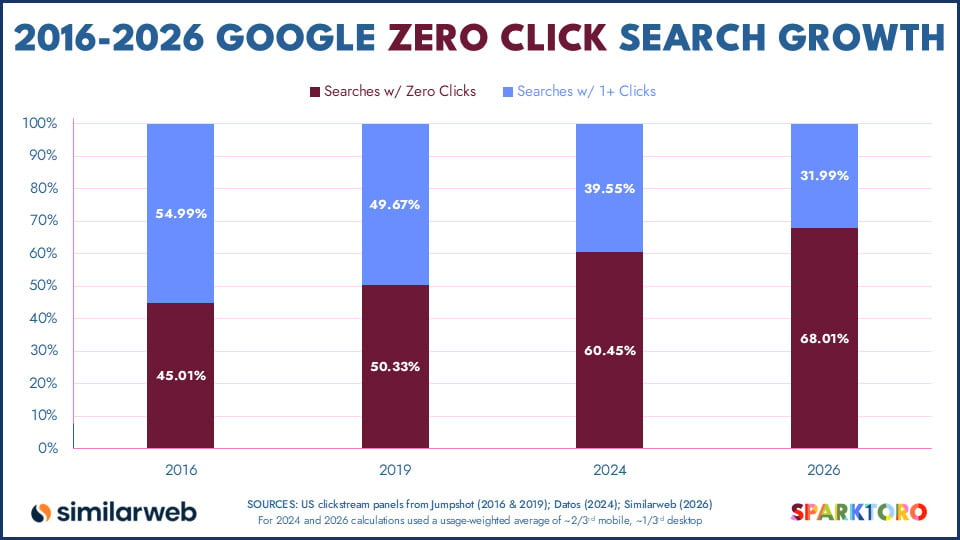
In 2024, using Datos clickstream data, SparkToro found that 58.5% of US searches ended with zero clicks, and only about 360 of every 1,000 searches produced a click to the open web. In the EU, that number was slightly higher at 374 clicks per 1,000 searches.
Bain & Company’s February 2025 research arrived at a similar conclusion from a different angle. Their consumer survey found that 60% of searches now end without the user clicking through. Even among consumers who are skeptical of AI, roughly half said most of their queries are answered directly on the search page.
How Often AI Overviews Show Up
When it comes to how often AI overviews show up, the numbers vary a bit, depending on the source. Different tools track different keyword sets, and the types of queries in the sample change the result dramatically.
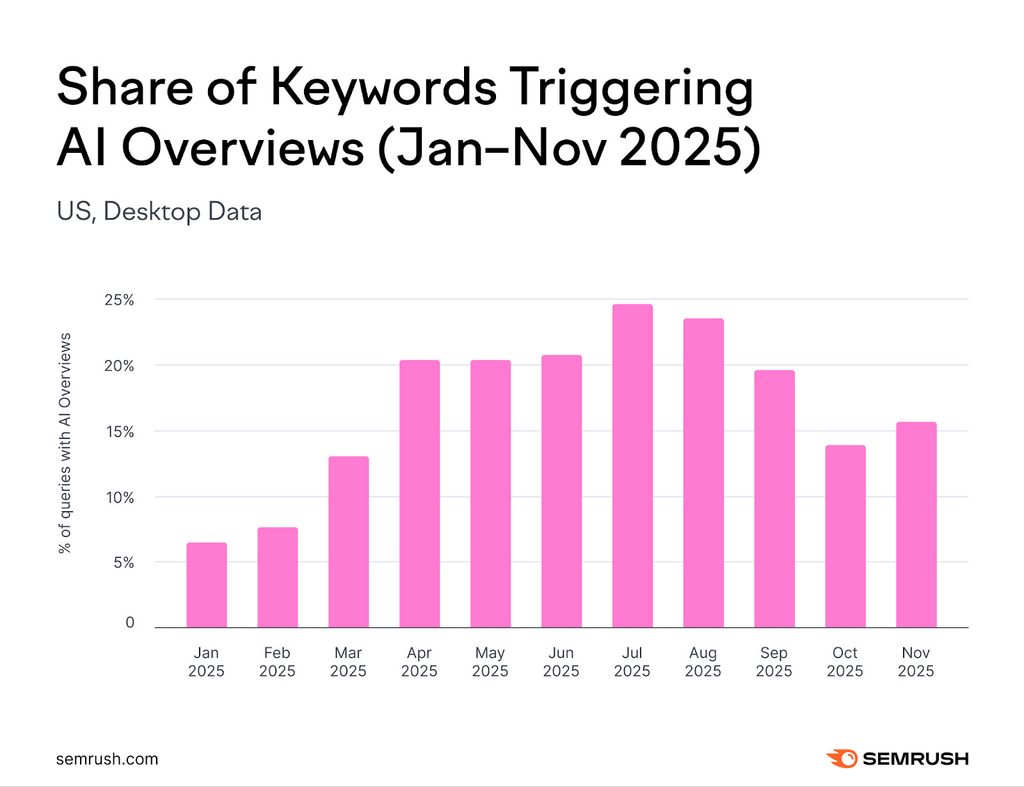
Semrush studied more than 10 million keywords throughout 2025 and found that AI Overviews appeared on 6.49% of queries in January, peaked at 24.61% in July, and settled at 15.69% by November. Nearly 60% of the keywords triggering AI Overviews had 100 or fewer monthly searches, so the feature has been weighted toward long-tail informational queries.
BrightEdge’s tracking, which uses a different keyword set, measured AI Overview presence at roughly 31% of tracked queries in February 2025, rising to about 48% by February 2026. At peak, more than half of all queries in their dataset showed an AI Overview.
Ahrefs analyzed 146 million SERPs and found that AI Overviews appear on 21% of all keywords, but 46% of queries with seven or more words and 57.9% of question-format queries. The longer and more conversational the search, the more likely an AI Overview shows up.
And from the user side, Pew’s browsing panel found that about 18% of all Google searches in March 2025 produced an AI summary, with 58% of study participants encountering at least one during that month.
📈 Trend Watch
Semrush’s data shows Google actively dialing AI Overviews up and back down throughout 2025, and the industry-level differences are significant. BrightEdge found education queries grew from 18% AI Overview coverage to 83% in a single year, while shopping queries remain below 3%.
What AI Overviews Do to Clicks
Three independent studies show that the scale of impact depends on what exactly you’re measuring.
Pew Research Center’s study is the most methodologically clean because it tracked actual browsing behavior rather than keyword-tool estimates. Across roughly 69,000 searches from 900 US adults in March 2025, they found that users clicked a traditional result just 8% of the time when an AI summary appeared, compared to 15% without one. Clicks on links inside the AI summary itself happened only 1% of the time. And users were more likely to end their browsing session entirely after encountering a summary (26% versus 16%).
Ahrefs measured the impact through Search Console data across 300,000 keywords and found that AI Overviews reduced the top result’s CTR by 58% as of December 2025. That’s a worsening from the 34.5% drop their earlier study measured using March 2025 data.
Seer Interactive tracked 25.1 million organic impressions across 42 organizations from June 2024 through September 2025. They found that organic CTR on queries with AI Overviews fell 61%, from 1.76% to 0.61%. Paid CTR fell even harder, dropping from 19.7% to 6.34%.
Seer challenged their own assumption and found that the queries triggering AI Overviews already had lower CTRs before the feature appeared. In June 2024, before AI Overviews had meaningfully rolled out, those queries were already converting at 1.76% versus 2.74% for queries that never triggered one. So AI Overviews are appearing on queries that were already less likely to generate clicks, then pushing those numbers further down.
AI Mode Takes It Further
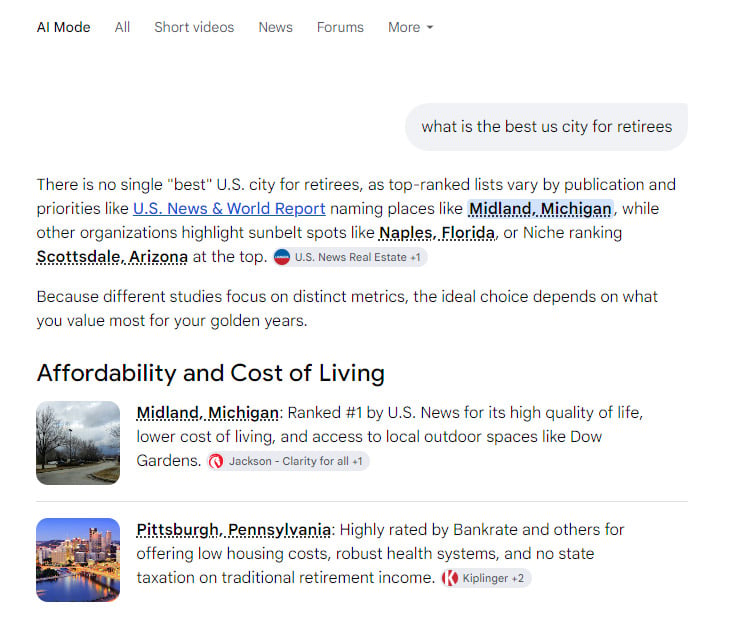
AI Overviews sit above traditional search results. Google’s AI Mode, which launched in the US in May 2025, replaces them entirely with a conversational interface. The difference in user behavior is significant.
Semrush analyzed nearly 69 million Google sessions from US desktop users between May and July 2025 and found that only 6% to 8% of AI Mode sessions led to a visit to an external website. That puts the zero-click rate at 92% to 94%, well above the rates measured for standard search with or without AI Overviews.
AI Mode is still small. During Semrush’s study period, it grew from about 0.25% of all search sessions to just over 1%, a roughly fourfold increase in two months. But the behavioral differences are noteworthy. AI Mode queries average 7.22 words versus 4.0 in traditional search, and users conduct fewer searches per session. They’re asking longer, more specific questions and getting more complete answers.
The zero-click rate also varies by intent. Semrush found that transactional searches in AI Mode still sent about 69% of users to a website. The 93% average is driven heavily by informational queries, where the AI is most capable of resolving the question without a click.
📖 Definition
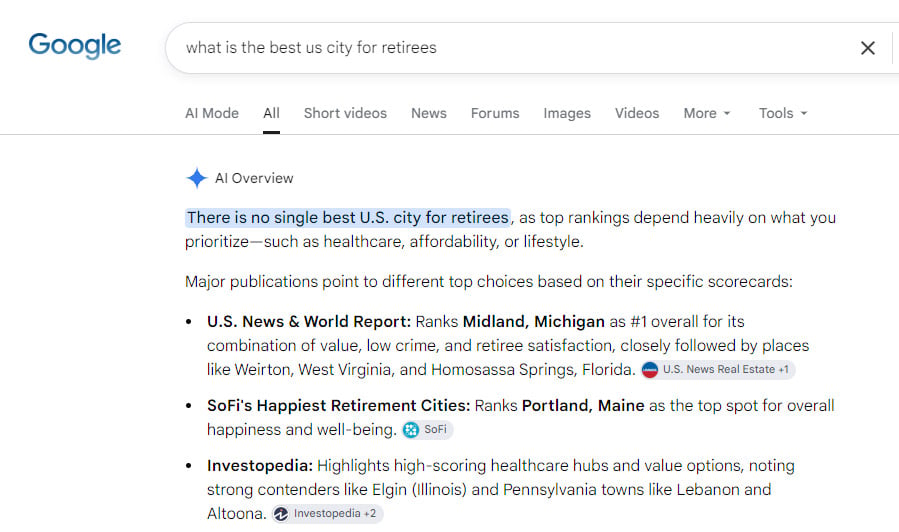
AI Mode and AI Overviews are different features. An AI Overview is a summary box that appears above the traditional search results. AI Mode replaces the traditional results entirely with a conversational, chat-style interface. That’s why AI Mode’s zero-click rate runs so much higher.
Who Still Gets the Clicks
The framing of “clicks are disappearing” is partially right but also oversimplified. Clicks are consolidating. Some types of content and some types of sites are still getting clicks, and the data on who those winners are is starting to come into focus.
Pew’s study found that government websites show up in AI summaries more than in standard results (6% of AI summary sources versus 2% for standard results). Wikipedia and large platforms also appear disproportionately in AI citations. Meanwhile, BrightEdge found that only about 17% of AI Overview citations come from content that also ranks in the organic top 10. The content Google’s AI cites and the content that ranks well in traditional search are largely different.
Being cited in the AI Overview helps. Seer found that brands cited inside an AI Overview earned 35% more organic clicks and 91% more paid clicks compared to brands on the same queries that weren’t cited. They include an important caveat, though. This is a correlation finding. Higher-authority brands may simply get cited more often, so it’s hard to say whether the citation itself caused the extra clicks.
💡Pro Tip
For informational content, the goal is shifting from ranking first to being the source that AI summaries pull from. Clear answer passages, well-structured headings, and specific, well-attributed facts are what get cited. If your content answers a question in 50 to 70 words near the top of the page, it’s more likely to end up in the overview.
The Business Impact
These numbers add up to real revenue consequences for companies that have relied on organic search as a traffic channel.
Bain & Company found that 80% of consumers now rely on AI-written results for at least 40% of their searches, and organic web traffic has declined an estimated 15% to 25% across many sectors as a direct result.
A separate Bain analysis found that click-through rates have fallen by as much as 30% in some B2B categories, including B2B software. That same research found that 85% of B2B buyers purchase from the vendor list they already had in mind before they started searching. If zero-click search means fewer chances to get on that list in the first place, the downstream effect on pipeline could be substantial.
The AI Search Habit
Zero-click search data tells us what’s happening inside Google. But the broader shift is that people are increasingly going outside Google for answers.
A Clear Spark Digital survey of 2,127 US adults in April 2026 found that 97.6% of respondents have used AI tools like ChatGPT, Gemini, or Copilot to find information. Nearly half (48%) use them daily. And 78.5% have made a real-life decision based on something an AI tool told them.
The relevant detail for anyone thinking about search behavior is that the same survey found that 72% of AI users still turn to Google when they want to verify what an AI tool tells them. Even among people who say they trust AI more than Google, 59% still use Google as their verification step. And only 18% of AI users say they always verify information from AI tools, despite nearly 80% using it to make decisions.
Bain’s research reinforces the trend from the other direction, finding that roughly 68% of LLM users rely on platforms like ChatGPT and Perplexity for researching and summarizing information.
🎯 Why It Matters
Trust in AI answers hasn’t killed the verification search. Many people still use Google to double-check what the AI told them. That means search isn’t just losing clicks to AI Overviews on its own results page. It’s also absorbing a new category of verification queries generated by AI tools. The shape of the search click is changing.
Google’s Response
Google has pushed back on the zero-click narrative. In August 2025, VP and Head of Search Liz Reid published a blog post claiming that total organic click volume from Google Search to websites has been “relatively stable year-over-year” and that “average click quality has increased.” The post described third-party decline reports as resting on “flawed methodologies, isolated examples, or traffic changes that occurred prior to the roll out of AI features in Search.”
When the Pew study was published, Google called it “a flawed methodology and skewed queryset that is not representative of Search traffic.”
The response drew sharp criticism from SEO practitioners. Several pointed out that Google shared no underlying data in the blog post to support its claims. Lily Ray, VP of SEO strategy at Amsive, pointed to the Google Search Console data that hundreds of site owners have shared publicly, showing impressions holding steady while clicks decline. SEO consultant Aleyda Solis noted that if the sites seeing increased traffic are primarily large platforms like Reddit and YouTube, that doesn’t contradict the claim that independent publishers are losing ground.
What Comes Next
At Google I/O 2026, Google announced that AI Overviews and AI Mode are merging into a single, continuous search experience, with conversational follow-ups flowing directly from AI Overview summaries into the deeper AI Mode interface. AI Mode already passed 1 billion monthly active users within its first year, with queries more than doubling every quarter since launch. If the 92% to 94% zero-click rate measured in AI Mode’s early days holds as these two surfaces blend together, the current numbers could look modest by comparison.
The companies adapting fastest aren’t trying to reverse the trend. They’re rethinking what a “search presence” actually means when the majority of users never leave the results page. Getting cited inside an AI-generated answer, building brand recognition that puts you on someone’s shortlist before they search, and creating content specific enough that an AI summary can’t fully replace it are all becoming more important than ranking for a high-volume keyword and waiting for the click.